

.webp)

You've tried medication. Maybe you've tried therapy too, or both at the same time, for long enough that you were told to expect results by now. And you're still waiting to feel like yourself again.
If you've been searching for TMS therapy near me, TMS near me, TMS Miami, or Transcranial Magnetic Stimulation while looking for what else is out there, this guide is meant to answer the questions that usually come up first.
TMS (Transcranial Magnetic Stimulation) is a non-invasive, FDA-cleared treatment for depression, used when other approaches haven't provided enough relief.
This guide walks through how it works, who it may be appropriate for, what a session actually feels like, how it compares to medication, and how insurance coverage typically works.
At ARC Mental Health in Miami and throughout South Florida, every one of these questions gets answered as part of a real evaluation, not a generic checklist.
What Is TMS Therapy?
TMS therapy for depression uses targeted magnetic pulses to stimulate specific areas of the brain involved in mood regulation. It's non-invasive, meaning there's no surgery, no incisions, and no anesthesia involved at any point.
Unlike antidepressant medications, TMS doesn't circulate through your bloodstream. The magnetic field is directed at a precise location on the scalp, and its effects stay localized to that region of the brain.
Sessions are performed on an outpatient basis, and you remain fully awake throughout.
How Does TMS Work?
Researchers believe depression is associated with reduced activity in certain areas of the brain involved in regulating mood. TMS, sometimes referred to as transmagnetic therapy, delivers repeated magnetic pulses to these regions.
This happens during a series of outpatient sessions, aiming to support healthier patterns of brain activity over time.
This isn't a single-session fix. It works cumulatively, which is part of why a full course of treatment involves multiple sessions spread across several weeks rather than one visit.
Who May Be a Candidate for TMS?
TMS may be considered for adults whose depression hasn't improved sufficiently with previous treatments, typically after trying medication, therapy, or both.
It's not usually a first step, but rather an option explored when earlier approaches haven't provided enough relief.
Every patient at ARC begins with a comprehensive psychiatric evaluation before TMS is ever recommended. Your provider reviews your treatment history, current symptoms, and overall health.
This helps determine whether it's a reasonable next option for your specific situation, rather than a default recommendation for anyone who asks about it.
"TMS candidacy isn't just about checking a box that says medication didn't work. We look at what's already been tried, how long, and how thoroughly — plus the patient's overall health and daily functioning. It has to make sense for that person's specific history, not just their diagnosis." — Dr. Juan Oms, MD, Psychiatrist, ARC Mental Health
What Happens During a TMS Session?
Many patients researching TMS therapy near me want a concrete picture of what a session actually involves, not just a general description.
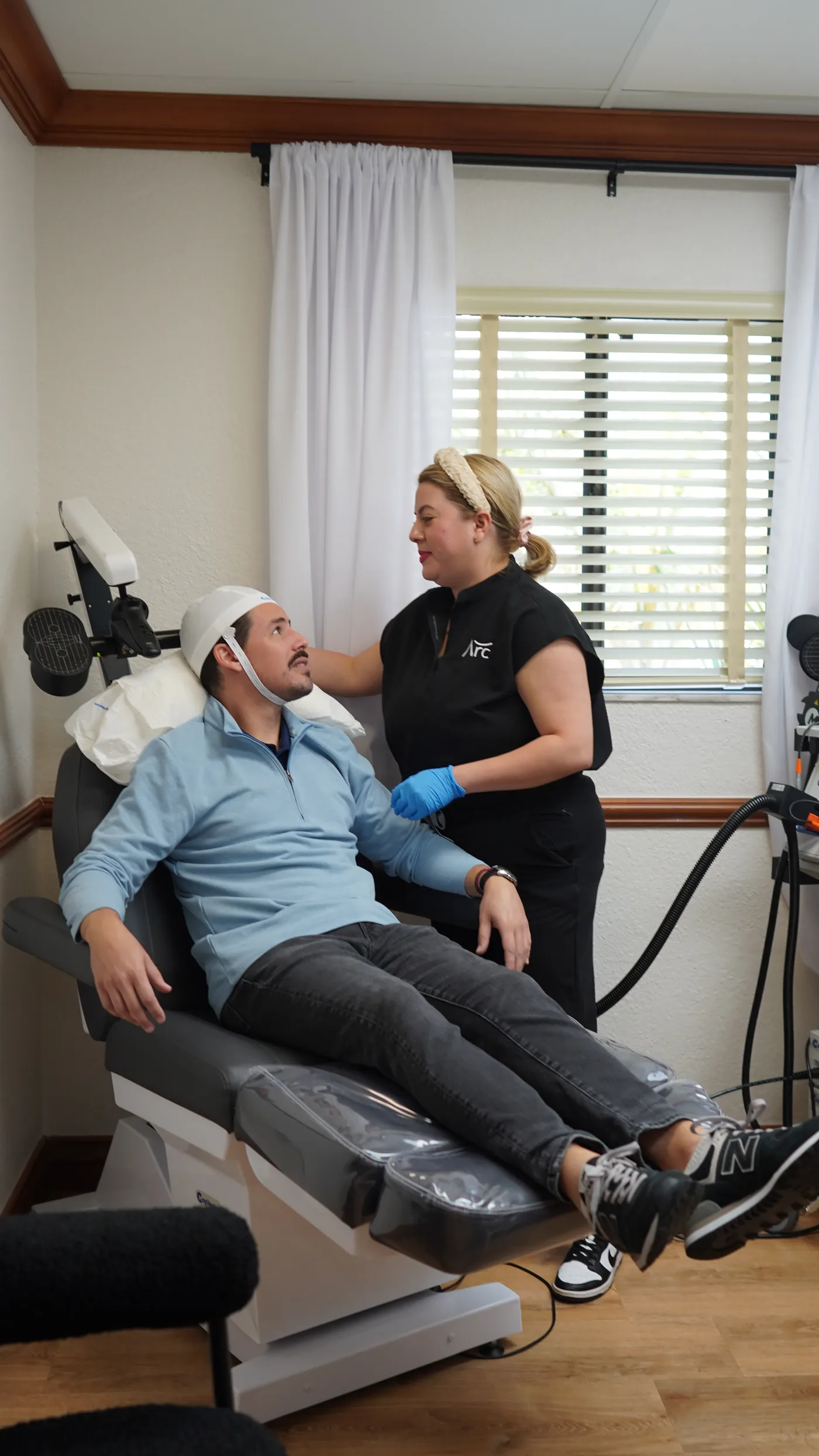
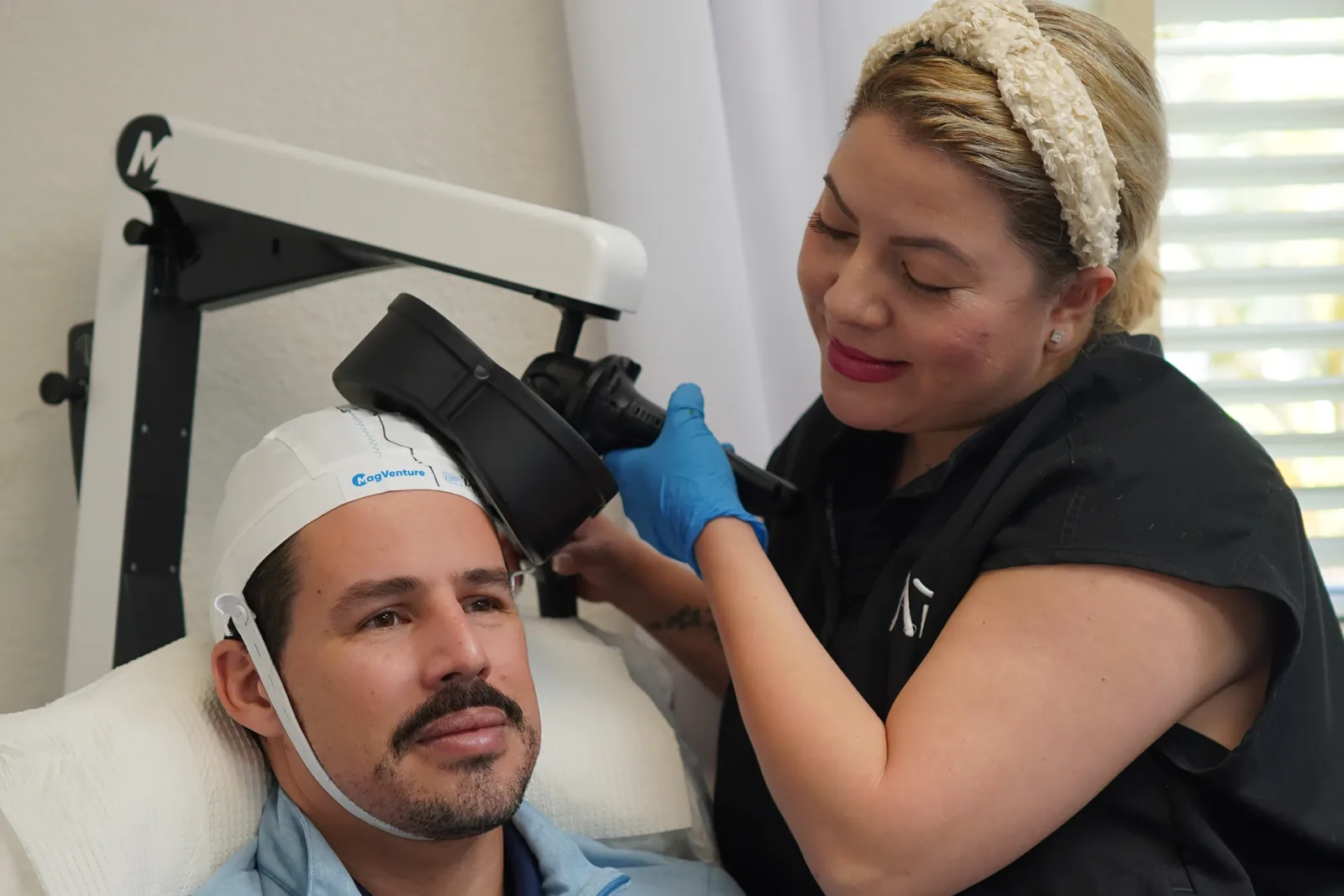
You sit comfortably in a chair, fully awake, with no sedation. A coil is placed gently against your scalp, near the front of your head.
You may hear clicking sounds and feel a light tapping sensation, which is the most common thing patients describe experiencing.
Each session generally lasts under an hour, and you can typically drive yourself home and return to your day immediately afterward.
A full course of TMS treatment usually involves multiple sessions across the week, continued over several weeks. Your care team at ARC builds this schedule around your specific evaluation results.
It can be adjusted over time based on how you're responding, rather than following a fixed calendar regardless of your progress.
What to Expect After Treatment
Many patients start to notice improvements within a few weeks of beginning treatment, though this varies by person and isn't something that can be guaranteed for any individual patient.
Some patients report mild scalp discomfort or a tapping sensation during the first few sessions, which often eases with continued visits.
These effects are generally described as minimal compared to the systemic side effects associated with some antidepressant medications, since TMS doesn't circulate through the bloodstream the way oral medication does.
Follow-up check-ins allow your provider to track your progress and adjust your plan as needed.
Depression treatment rarely moves in a perfectly straight line, and small adjustments along the way are a normal, expected part of the process.
TMS vs. Medication: What's the Difference?
It's common for patients to wonder whether TMS is meant to replace medication, or how the two actually compare.
They work in fundamentally different ways, and understanding that difference can make the decision easier to think through.
Antidepressant medications work systemically, circulating through your bloodstream and affecting neurotransmitter activity throughout the body. This is part of why they can come with a broader range of potential side effects.
TMS, by contrast, targets a specific brain region directly through magnetic pulses, without circulating through the bloodstream, which is part of why its side effect profile tends to be more limited and localized.
TMS is typically considered after medication hasn't provided sufficient relief, rather than as a replacement chosen from the outset. For many patients, TMS becomes part of a broader plan that may still include medication, therapy, or both.
Which combination makes sense is a conversation to have directly with a psychiatric provider familiar with your full history.
Is TMS Covered by Insurance?
Cost is one of the first practical questions most patients have, and it's worth asking early rather than after you've already committed to a plan.
ARC Mental Health accepts Medicare, Medicaid, and most major insurance plans. Our office can help verify your specific benefits before you begin treatment, so you're not left guessing about cost.
How to Prepare for Your First TMS Appointment
Walking into an unfamiliar appointment is easier when you have a general sense of what to expect.
It helps to arrive with a summary of what you've already tried for depression, including medications and therapy, and how each of those went.
Since you'll be sitting for the session, comfortable clothing is a reasonable choice, though there's no special preparation required beforehand the way there might be for some other procedures.
Beyond the practical details, the most useful thing to bring is a clear list of your own questions.
Your first evaluation is as much about you deciding whether this feels like the right fit as it is about your provider assessing candidacy.
Common Questions About TMS
Does TMS hurt?
Most patients report only mild discomfort during a session, often described as a tapping sensation on the scalp. It's not typically described as painful.
Can I drive myself home after a session?
Yes. Because TMS doesn't involve sedation or anesthesia, most patients are able to drive themselves home and return to their normal activities right after a session.
How long does a full course of treatment take?
This varies by patient, but treatment generally involves multiple sessions per week over the course of several weeks, based on your specific evaluation and how you respond.
Common Misconceptions About TMS
Myth: TMS is painful.
Reality: Most patients describe only mild discomfort, such as a tapping sensation, rather than pain.
Myth: TMS requires surgery.
Reality: TMS is a non-invasive, outpatient treatment. There are no incisions and no anesthesia involved.
Myth: TMS works the same way for everyone.
Reality: Responses vary by person, which is why a comprehensive evaluation comes before any recommendation to start treatment.
Frequently Asked Questions
Is TMS safe?
TMS is FDA-cleared and has been extensively studied. It's generally considered safe for most patients, though a psychiatric evaluation helps confirm it's appropriate for your specific situation.
Is TMS covered by insurance?
Many commercial insurance plans cover TMS for depression, and it's also covered under Medicare in many cases. Our office can help verify your specific benefits.
Will insurance cover this, and how long does approval take?
Yes, insurance covers this treatment, and the approval process typically takes about two weeks.
How many sessions will I actually need, and how many per week?
We use the most widely researched protocol proven to be effective. It requires committing to sessions several days per week for a period of six weeks.
How is TMS different from medication?
TMS targets a specific brain region directly through magnetic pulses and doesn't circulate through the bloodstream, while medication works systemically throughout the body. Many patients use TMS alongside medication rather than instead of it.
Will I need to keep seeing my psychiatrist during TMS treatment?
Yes. TMS is part of an ongoing treatment plan, and your provider continues to monitor your progress and overall care throughout the course of treatment.
What if TMS doesn't work for me?
Your provider will reassess your treatment plan at follow-up visits. Not responding to TMS doesn't mean no other options exist; it's information that helps guide what comes next.
Can I return to work the same day as a session?
Yes. Most patients return to their normal daily activities, including work, immediately after a session, since there's no sedation involved. You'll typically be in and out in under an hour and able to return to your regular activities.
Why Choose ARC Mental Health for TMS?
At ARC Mental Health, we offer TMS therapy at our South Miami location, with fully bilingual care (English/Spanish) throughout your treatment. Every TMS plan starts with a comprehensive psychiatric evaluation, and because we also offer Spravato, psychiatric care and medication support, and therapy under the same roof, TMS is coordinated with the rest of your care rather than treated in isolation. We work directly with your insurance to help simplify authorization, and we serve patients throughout South Miami, Kendall, Coral Gables, Pinecrest, Sunset, and Coconut Grove.
That same evaluation-first approach means no two treatment plans look exactly alike. Our team is available to answer your questions about candidacy, cost, and what to expect, in both English and Spanish, before you commit to anything.
Take the Next Step
If you've been exploring new treatment options for depression and TMS is one of them, you don't have to figure out on your own whether it's the right fit.
At ARC Mental Health in Miami, South Miami, Kendall, Coral Gables, Pinecrest, Sunset, and Coconut Grove, our team can walk you through a full evaluation and answer your questions about insurance coverage.
Reach out to schedule a free initial consultation
Take that next step at your own pace.
TMS is currently offered at our South Miami location: 7241 SW 63rd Ave., Ste. 101-A, South Miami, FL 33143.
.png)